The SDGs cluster is Universitas Sriwijaya's end-to-end ecosystem for the 17 United Nations Sustainable Development Goals: collecting evidence of what the university actually does, curating and verifying it, measuring it against targets, and publishing it to the world.
The idea
Four platforms, one shared database. Nothing is entered twice: what a faculty submits once flows into the public microsite, the analytics dashboard, the monitoring portal and the open data API without re-keying.
How the four platforms fit together
- SDGs News — the public face. Articles, agendas, reports, policies and a page for each of the 17 goals.
- SDGs Dashboard — the open analytics screen. Live counts, trends and faculty comparisons, no login required.
- SDGs Management System — the engine room. Evidence submission and verification, automated news and publication harvesting, NLP classification, user and role management.
- SDGs Monitoring & Evaluation — the performance layer. Targets versus realisation, scoring, evaluation and follow-up, period reporting.
Upstream and downstream
The first three platforms answer "what do we have?". The Monev portal answers "are we hitting our targets, which unit is lagging, and what happens next?" It reads the same tables rather than duplicating them.
Who it is for
The public and the press (News, Dashboard), faculty and unit administrators (Management System), and university leadership, the SDGs Centre and ranking assessors (Monev, reports).
The Equity cluster covers Universitas Sriwijaya's Equity program — the university's equity, access and community-empowerment initiative — together with the systems that run and expose its data.
The idea
Where the SDGs cluster measures sustainability impact, the Equity cluster focuses on fairness of access and participation: who gets to take part in higher education, under what conditions, and with what support.
The three platforms
- UNSRI Equity Program — the public information site for the program.
- SIM Equity — the management information system used by the program team to record and administer data.
- WCU API — the programmatic interface that lets other systems read Equity and World Class University data.
Operated separately
These three run on their own infrastructure, outside this application. They are linked from this portal for convenience; accounts, permissions and support for them are handled by the Equity program team.
The THE cluster is reserved for Universitas Sriwijaya's participation in the Times Higher Education Impact Ratings — the global rating that scores universities against the United Nations Sustainable Development Goals.
What the THE Impact Ratings are
Unlike rankings built on reputation or research volume alone, the Impact Ratings assess how a university contributes to the SDGs through four lenses: research, stewardship of its own resources, outreach to the community, and teaching. Universities submit metrics and supporting evidence goal by goal.
How scoring works
SDG 17 (Partnerships for the Goals) is compulsory for every participating university. On top of that, an institution's best three remaining SDG scores are counted towards the overall result, so a university does not have to submit for all seventeen goals to be ranked.
Status of this module
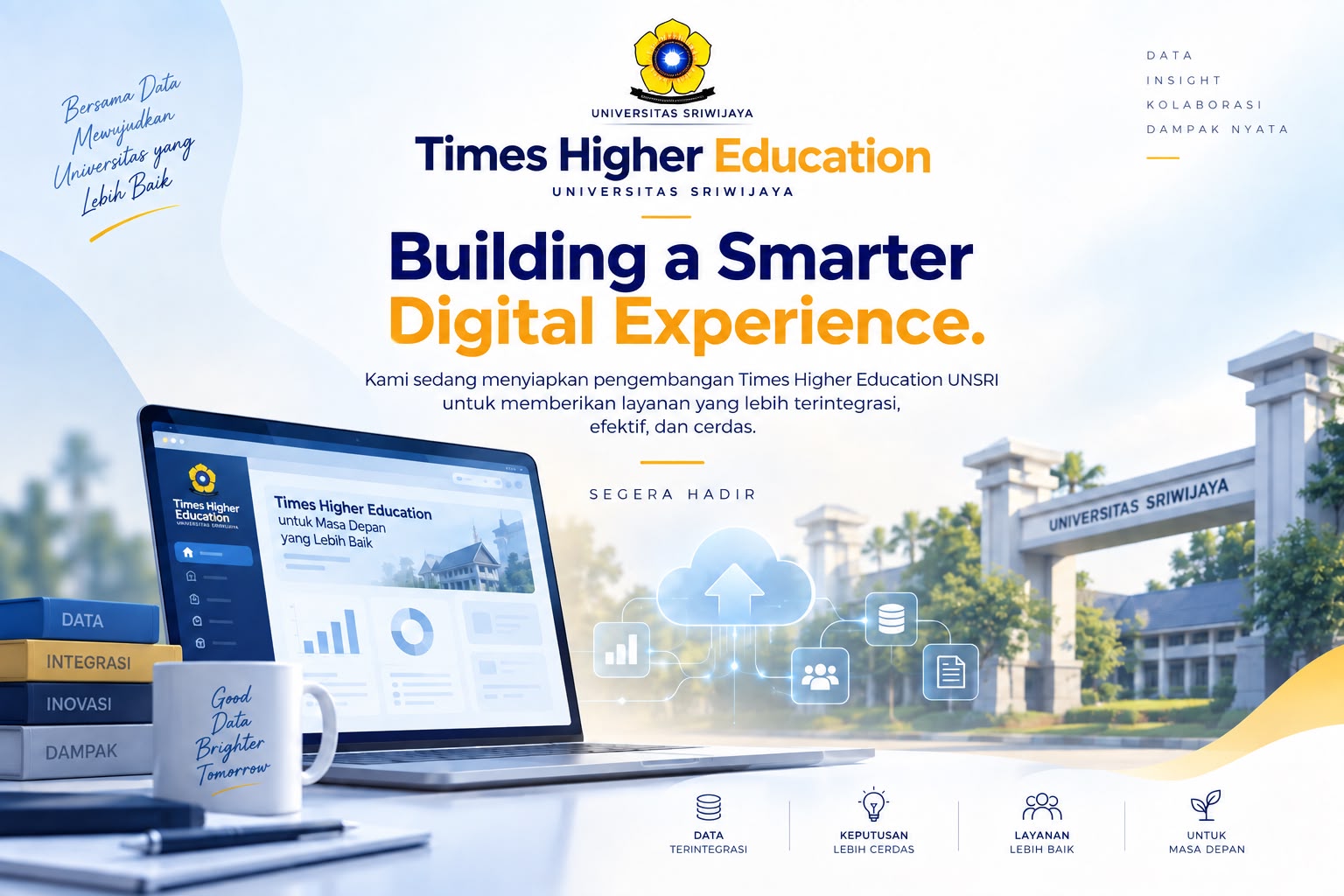
A dedicated THE workspace — indicator submission, evidence packaging and score tracking — is still under development. In the meantime, THE-related work already lives inside the SDGs Management System: every piece of evidence can be tagged with a THE Impact indicator, and the system produces a THE-oriented report from that tagging.
This category is a placeholder. Clicking its card shows an "under development" notice rather than opening a platform.
The public microsite of SDGs Universitas Sriwijaya — the window through which the public, the media and ranking assessors see what the university is doing for the Sustainable Development Goals.
What it is
A bilingual (Indonesian / English) public website with its own content management system for editors. It is served from the same application and the same database as the management system, so published content and internal evidence never drift apart.
What you will find
- A page for each of the 17 SDGs, gathering the university's work under that goal.
- News articles and agendas with individual detail pages.
- Reports and policy documents mapped to the goals they support.
- A handbook section, plus about, contact and full-text search.
Behind the scenes
Editors work in a CMS at /websites/admin, gated by the same role model as the rest of the system — one login, one session, one source of truth for permissions.
Who it is for
Everyone. No account is needed to read it.
A full-screen, public analytics view of the university's SDG data — built to be projected in a meeting room or left running on a display, not just read at a desk.
What it is
A read-only visual summary generated live from the SDG database. It requires no login, so it can be shown to visitors, auditors and assessors without provisioning accounts.
What it shows
- Headline counts — total evidence, verified, pending verification, drafts.
- Distribution by SDG — how the university's contribution spreads across the 17 goals.
- Faculty comparison and a ranking of the top contributing faculties.
- Monthly trend of submissions, so activity over time is visible at a glance.
- Recent evidence and the pending verification queue.
- Recent activity from the system's audit log.
- THE-curated evidence grouped by category, for ranking-oriented reading.
Who it is for
Leadership briefings, public display, and anyone who wants the numbers without navigating the internal system.
The core internal system — where SDG evidence is collected, classified, verified and turned into reports. Everything else in the SDGs cluster reads from what happens here.
Evidence workflow
Each piece of evidence (an activity, a program, a piece of research, a community initiative) moves through draft → submitted → verified or rejected. Verification is centralised in the SDGs team, so standards stay consistent across faculties, and rejections carry a written reason.
Tiered users and scopes
Access is organised by level — university, faculty, department (jurusan), study program (prodi) and organisational unit — across a nine-role model, with access that can be bounded by reporting period. An administrator only ever sees and edits their own scope.
Automated data intake
- News harvester — collects UNSRI news items for curation instead of manual copying.
- Publication ingestion — pulls lecturer publications (OpenAlex-led) with author and SDG mapping.
- NLP classification — suggests multiple SDGs per item with a confidence score; a human still approves.
- Policy records — institutional policies mapped to the goals they serve.
Reporting and open data
Built-in SDG reports, a THE-oriented report and faculty dashboards. All data is also exposed through an Open Data API v2 at /api/v2, documented with OpenAPI 3.1 and a dataset catalogue; tokens are optional and only raise the rate limit.
Also inside
Activity logging, notifications, master data management, API token administration and backups.
Who it is for
Faculty and unit administrators, the SDGs team as verifiers, and system administrators. An account is required.
The performance layer. The management system records what the university has done; the Monev portal answers whether it is on target, which unit is falling behind, and what will be done about it.
The full cycle
Plan → Target → Realisation → Verification → Evaluation → Follow-up. Each stage is a screen in the portal rather than a spreadsheet passed around by email.
Multi-framework indicators
One indicator library covering several frameworks at once: THE Impact Ratings, the national SDGs framework (Bappenas), IKU for state universities, and UNSRI's own internal indicators.
Targets and realisation
- Targets and baselines set per indicator, per period, per unit — university down to study program.
- Realisation entered manually within a unit's scope, or computed automatically from data already in the system: verified evidence, publications, harvested news and policies.
- Central verification by the SDGs team, with a guard that locks a period once it is closed.
Reading the results
Achievement scores, traffic-light status per SDG and per unit, trends across periods, and a ranking of faculty contribution — a cockpit for leadership instead of a manual recap request.
Evaluation and follow-up
Evaluators record findings against an automatic snapshot of the gap, then raise recommendations with a named owner, a deadline and a status. Open recommendations carry over into the next period so nothing quietly disappears.
Reporting
Period reports are generated as DOCX and XLSX files covering period identity, summary, scoreboard, SDG distribution, faculty contribution, evaluations and recommendations. Files are stored with a SHA-256 checksum and downloaded from the report history.
A separate door
The Monev portal has its own login at /monev/login and its own session. A Monev account cannot sign in through the main system login, and signing in to Monev does not open the Evaluation portal — each gate is deliberately independent.
The public site of the Universitas Sriwijaya Equity Program — the university's initiative for equality of access, participation and empowerment across its academic community.
What it is
The program's public front door: what the Equity Program is, what it aims to achieve, and what it is currently doing. It is the place to point someone who has heard of the program and wants to understand it.
What you will typically find
- Program profile, objectives and scope.
- Activities, announcements and updates.
- Published outputs and documentation from the program.
How it relates to the SDGs cluster
Equity work contributes directly to goals such as quality education, gender equality and reduced inequalities. Where that work produces evidence, it can also be recorded in the SDGs Management System and counted towards the university's SDG reporting.
Hosted separately
This platform runs on its own infrastructure, outside this application. This portal only links to it; the Equity program team owns its content and support.
SIM Equity — Sistem Informasi Manajemen Equity — is the operational back office of the Equity Program: the system in which the program's data is recorded, administered and reported.
What it is
Where the public site tells the story, SIM Equity holds the working data behind it. It is an internal system: an account issued by the Equity program team is required.
What it is used for
- Recording and administering program data and participants.
- Managing activities, documents and supporting evidence.
- Producing the program's internal reporting and recaps.
Why it is separate from the SDG system
The Equity Program has its own workflow, its own data model and its own reporting obligations. Keeping it in a dedicated system avoids bending the SDG evidence workflow to fit a different purpose, while both remain reachable from this single portal.
Hosted separately
Runs on its own infrastructure outside this application. Access requests and support go to the Equity program team.
The programmatic interface for World Class University and Equity data — the machine-readable route into the same information the other platforms display.
What it is
An HTTP API with its own endpoint documentation. Instead of exporting a spreadsheet and re-keying it somewhere else, another system can read the data directly and stay in step automatically.
What it is for
- Integrating WCU achievement and incentive data into other university systems.
- Feeding dashboards, reports or third-party tools from a single source.
- Letting developers explore the available endpoints before wiring anything up.
Not the same as the SDG Open Data API
This portal exposes a second, separate API: the SDG Open Data API v2 at /api/v2, which serves SDG evidence, publications, harvested news, policies, monev data, microsite content and dashboard summaries, documented with OpenAPI 3.1. If you are after SDG data, that is the one to use.
Hosted separately
Runs on its own infrastructure outside this application, alongside the other Equity platforms.
A dedicated workspace for Universitas Sriwijaya's submission to the Times Higher Education Impact Ratings. This module is still under development.
What the rating measures
The THE Impact Ratings assess universities against the United Nations Sustainable Development Goals across four dimensions: research, stewardship of the institution's own resources, outreach to the wider community, and teaching. Each goal has its own metrics, and each metric must be backed by verifiable evidence.
How the score is built
SDG 17 (Partnerships for the Goals) counts for every participating university. Beyond that, the best three of a university's remaining SDG submissions are taken into the overall score — participating in a focused set of goals well is better than spreading thin across all seventeen.
What this module will do
- Organise submissions metric by metric for each SDG.
- Package the supporting evidence required for each metric.
- Track scores and results across rating cycles.
What you can use today
THE work is already possible in the existing systems: every piece of evidence in the SDGs Management System can be tagged with a THE Impact indicator, the system produces a THE-oriented report from that tagging, and the Monev portal carries THE Impact Ratings as one of its indicator frameworks.
Clicking the THE card on this page shows an "under development" notice. This page will be updated once the module goes live.